Shut it off at the main first — then tell us what’s happening. Not sure where the valve is? Start here.
Half the housing in the Lakes Region shuts down for five months a year, and it’s the water system that decides whether it survives the winter. We handle the seasonal side that everyone else treats as an afterthought — and all the everyday plumbing a year-round house needs, in twenty towns.
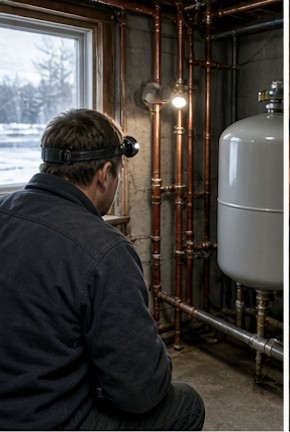
You describe it, we tell you what it likely is, what it should cost, and honestly when we can be there.
Describe the problem in plain words. Photos help. If it’s an emergency, say so in the first line and we treat it that way.
What it probably is, what it should cost, and a real arrival window — not a four-hour guess that turns into tomorrow.
You know the number before anyone opens a wall. If we find something different once we’re in, we stop and tell you.
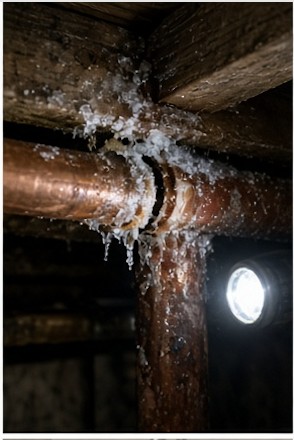
Burst and frozen pipes, active leaks, no water, sewage backups. Including empty seasonal houses where a neighbor or an alarm found the problem before you did.
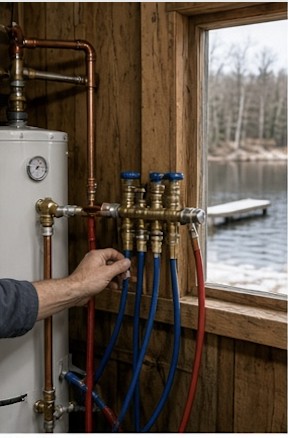
Wells drained, lines blown out, every trap treated, and a written record of what was done — so whoever opens the house in May knows exactly what they’re walking into.
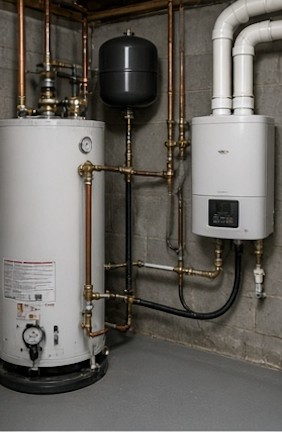
Tank and tankless, sized for your household and our cold inlet water — not just matched to whatever failed. Honest repair-versus-replace advice included.
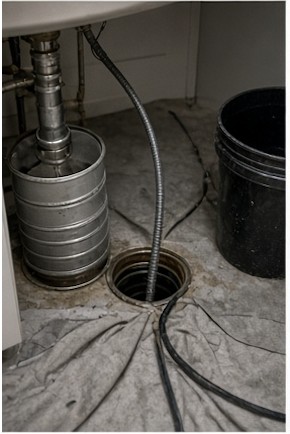
Sinks, tubs, toilets, and main lines cleared — plus why it clogged, so you’re not paying for the same visit three times a year.
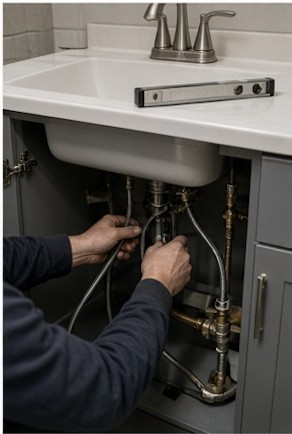
Faucets, toilets, shut-off valves, tub and shower work, and remodel rough-in done with the venting right the first time.
We publish our benchmark ranges for every job on this list, with sources. Nobody else in this region does. Read it before you call anyone — including us.

Every plumber in the region will winterize a camp. Very few treat it as the specialty it actually is. Draining a well system is not draining a town supply. A water softener resin tank holds water and cracks. So does an ice maker line, a dishwasher pump housing, an outdoor shower, and a dock hose bib.
Nationally, more than 20,000 frozen-pipe and winter water-damage claims were filed between 2024 and mid-2025, totaling over $628 million paid, with the average claim above $30,000. Almost all of it is preventable in ninety careful minutes each fall.
Nobody else in this region publishes a single calculator. We publish three, and they’re genuinely useful whether or not you ever call us.
Water coming in? Six branches, each with what to do in the next sixty seconds.
Answer eight questions, print a shutdown and spring-startup checklist built for your property.
What size you actually need, tank or tankless, and what it should cost installed.
Winnipesaukee, Winnisquam, Squam, and Newfound, plus the hill towns between them. Not sure whether your place is on town water or a private well? We mapped that for all twenty towns.
Plumbing work in New Hampshire is performed under a state plumbing license, and permits get pulled when the job needs one. That’s not a selling point, it’s the baseline — and it matters, because unpermitted work complicates insurance claims and house sales years later.
What actually makes a difference is the boring stuff: we tell you when a repair beats a replacement, we give you the number before we start, and we say honestly when we can’t get there fast enough and someone else can.
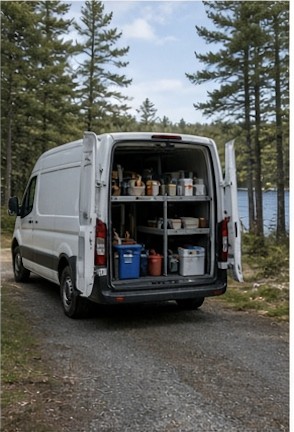
Shut the water off first. On town water that’s the main valve where the line enters the building. On a well it’s the valve after the pressure tank, plus the pump breaker so it can’t refill. Then cut power to any circuit near standing water, open a low faucet to drain the pressure out of the line, and photograph everything before you clean up. Full step-by-step in the emergency triage tool.
Be finished by the end of October. The first hard freeze here can arrive in early November and doesn’t wait for your schedule. Waterfront and private-road properties should book earlier still — the whole region needs the same four-week window and the calendar simply runs out. See the full shutdown guide.
A standard tank runs $1,400–$2,600 installed here depending on size and fuel. Tankless runs $3,800–$6,800 installed, more if gas line or venting work is needed. Our cold inlet water — low 40s on most wells for much of the year — cuts a tankless unit’s real output well below its rated flow, so it has to be sized bigger here. Size yours in about a minute.
Depends on the town and often on the street. Laconia, Franklin, Tilton, Northfield, and the villages of Meredith, Wolfeboro, Ashland, Bristol, and Plymouth have municipal service in their built-up areas. Gilmanton, Sanbornton, New Hampton, Tuftonboro, Barnstead, and most of Moultonborough are effectively all private wells. We mapped all twenty towns.
Generally it covers the water damage and not the pipe itself — and most policies require you to have kept the house at a minimum interior temperature, commonly 55°F, or shut the water off if the home was vacant. The New Hampshire Insurance Department publishes guidance on this. Photograph everything before cleanup and call your carrier the same day.
How to close a lake house properly, how to open one without flooding it, what tank-versus-tankless really means with 42°F well water, where every shut-off in your house is, and which towns have municipal water and sewer — read the guides or hit the local resource hub.
Describe what’s happening and where the property is. We’ll come back with a straight answer on what it likely is, what it should cost, and when we can be there. If it’s an emergency, say so in the first line.
We reply to every request within 2 business hours.